How to Get Rid of Oriental Bittersweet on Your NH Property
If you’ve walked a wooded lot in Southern New Hampshire and seen trees draped in thick, twisting vines with clusters of orange-and-red berries, you’ve probably met oriental bittersweet. It looks festive around the holidays — which is exactly how it got spread across New England in the first place — but it’s one of the most damaging invasive plants a homeowner can have on their land, and it’s a detail that comes up more often than you’d think during home inspections and land walk-throughs.
Here’s what it is, why it matters if you own or are buying property, and how to actually get rid of it.
Why It’s a Problem, Not Just an Eyesore
Oriental bittersweet (*Celastrus orbiculatus*) was brought to the U.S. from East Asia in the 1860s as an ornamental. It has since naturalized into an aggressive invader of natural areas, choking out native plants and smothering stems and trunks — in heavily infested areas it can form nearly continuous blankets across whole stretches of woodland. It winds tightly around host trees and shrubs, eventually girdling and killing them, and can climb as high as 60 feet into the canopy.
For a property owner, that means:
- Tree loss. Mature trees strangled or toppled under the sheer weight of vines are a real liability and a real cost to remove.
- Curb appeal and buyer perception. A yard or wood line visibly overtaken by vines reads as neglect, even when the house itself is in great shape.
- It spreads. These vines root wherever they touch the ground, and birds carry the berry seeds even farther. One untreated patch can turn into a much bigger problem — for you and your neighbors — within a few seasons.
How to Identify It
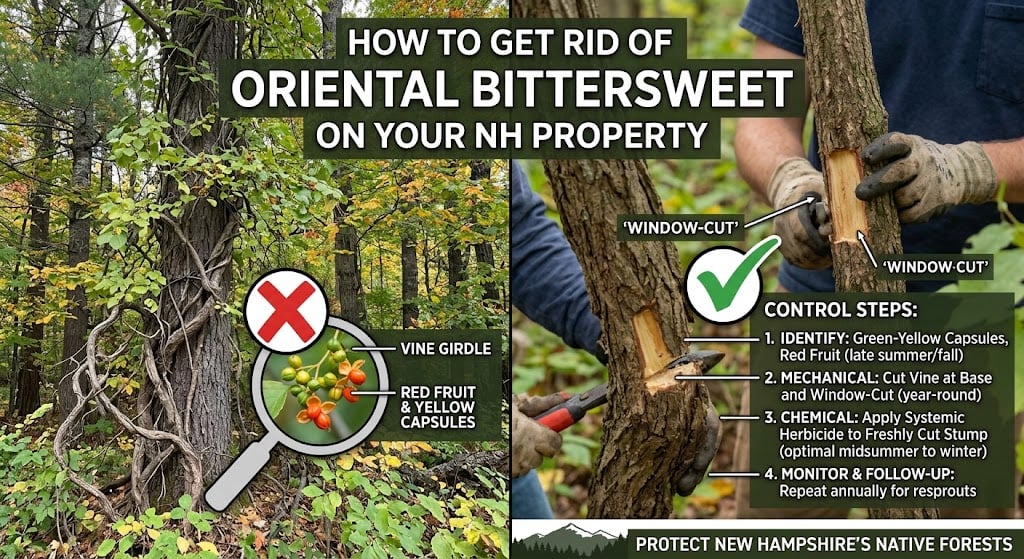
The clearest identifier is underground: the root system often shows a vibrant orange color just below the soil surface. Above ground, fruit clusters grow along the length of the stem at the leaf joints. That’s the key difference from the native, non-invasive American bittersweet, which only fruits at the very tips of its stems. If you’re not sure which one you’ve got, it’s worth confirming before you start pulling — the native version is worth protecting.
Removal: What Actually Works
The uncomfortable truth is that this isn’t a one-afternoon job. Cutting the vine without a follow-up plan just lets it re-sprout and keep spreading. Cut vines can regrow from the stump or from root fragments left behind, which is why the most effective approach pairs mechanical cutting with a systemic herbicide that kills the root — or, if you’d rather go chemical-free, a lot of persistent repeat cutting.
1. Cut the heavy vines first, safely.
For vines already up in tree canopies, don’t pull them down. Large dead vines are strong enough to bring down fragile branches as “widow-makers,” or to strip bark and kill the host tree if yanked out. Instead, use the “window-cut” method: cut each vine in two spots — once at the ground and again around eye level. This locates and severs every vine and clears the base for follow-up treatment. The vine left hanging in the tree will drop its leaves, dry out, and break down on its own over time.
2. Treat the cut stump.
Cut-stump herbicide treatment can be done nearly any time of year, except during heavy spring sap flow. Triclopyr is generally considered more effective than glyphosate for killing the root system when applied directly to a freshly cut stump, following the product label.
3. Stay on top of resprouts.
Going chemical-free is doable, but it’s a bigger commitment: vines left to regrow after cutting can still be managed without herbicide, it just takes more time and vigilance. New sprouts need to be removed as soon as they appear, before they can store energy for another round of growth, and this has to be repeated until the root system is exhausted. Don’t skip a season — missing even one cutting cycle is often enough to let the vine fully recover. Mowing isn’t a shortcut either; it’s been shown to encourage root sprouting rather than control it.
4. Hand-pull small seedlings.
For light infestations or new seedlings, hand-pulling works well, especially in moist soil. Just be sure to get the entire root crown and as much of the orange root as possible — leftover fragments can resprout.
5. Dispose of it properly.
Don’t leave cut vines on the ground or toss them in a brush pile if they’re fruiting — the berries can still spread from there. Bag vine and root debris for trash pickup, or pile debris away from bare soil and let it fully dry before burning, where local ordinances allow.
## Plan on a Multi-Year Effort
This is the part sellers and buyers alike need to hear: a real bittersweet infestation is a multi-year project, not a weekend fix. The standard recommendation is an integrated approach — cutting, chemical follow-up, and ongoing monitoring — carried out over several growing seasons, not a single knockout treatment.
## What This Means If You’re Buying or Selling
- Sellers: If bittersweet has taken hold along a tree line or fence, tackling even the most visible vines before listing photos and showings makes a real difference. Overtaken trees catch a buyer’s eye, and it can read as deferred maintenance on the whole property.
- Buyers: Bittersweet on a wooded lot isn’t a dealbreaker, but it’s worth factoring into your plans and budget, especially if mature trees near the house could eventually be compromised.
If you’re evaluating a property in the Southern New Hampshire and want a second set of eyes on the land — not just the house — I’m happy to walk it with you.