Every year, the New Hampshire legislature passes a batch of new laws that quietly reshape how real estate works in our state — from zoning rules that affect what can be built next door, to landlord-tenant procedures, to what happens with that old oil tank buried in your yard. 2026 was a particularly active year, with several bills aimed squarely at New Hampshire’s ongoing housing supply challenges.
As a Realtor working across Southern New Hampshire, I track these changes closely because they affect real, practical decisions — what you can do with a property, how a transaction unfolds, and what disclosures matter. Here’s a full rundown of what’s changing, organized by what’s likely to affect you most.
## Housing Supply & Zoning: The Big Shifts
New Hampshire has spent years wrestling with housing supply, and this legislative session pushed several bills forward that continue chipping away at local zoning barriers.
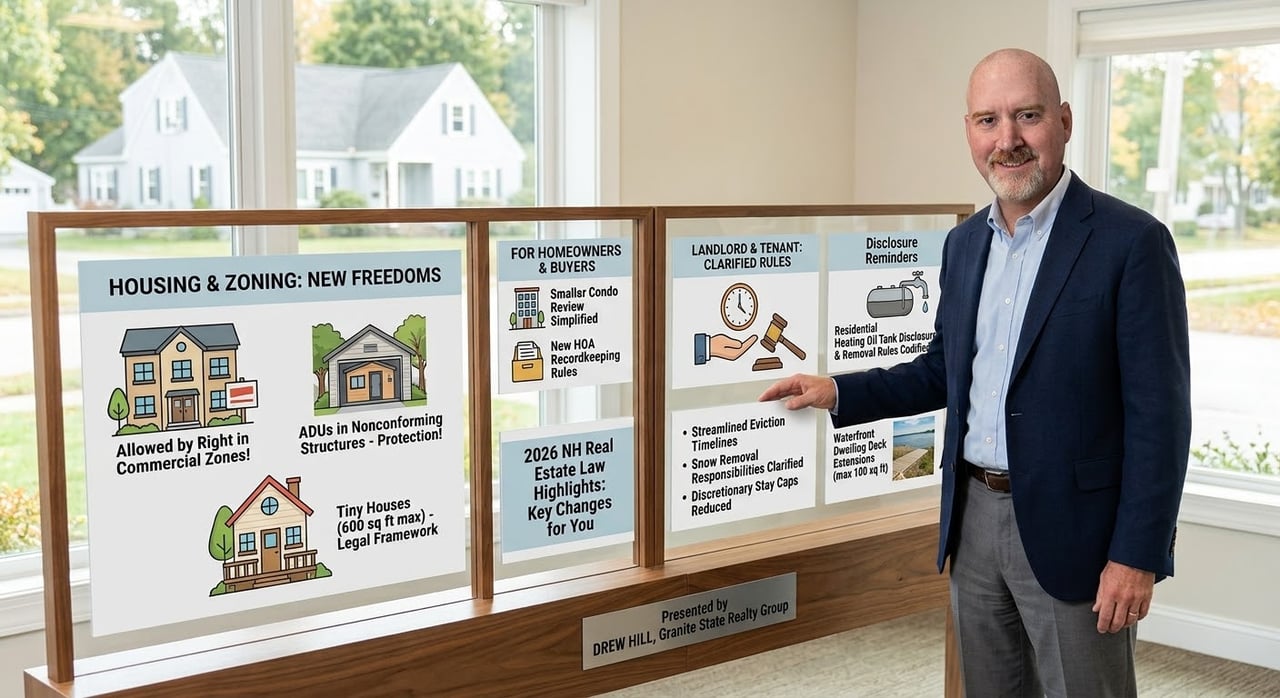
Multi-family housing in commercial zones gets teeth. House Bill 1010 and House Bill 1588 build on 2025’s House Bill 631, which first opened the door to multi-family construction in commercial districts. The new laws clarify how that actually works in practice. HB 1010 addresses infrastructure adequacy — if a town says infrastructure isn’t sufficient, the developer can provide it themselves, though the planning board can require a traffic study or proof of water system access. HB 1588 goes further: multi-family units in commercial zones must now be allowed as a matter of right, and towns cannot pile on requirements beyond what’s expressly authorized in the statute. Municipalities can set frontage, setback, and height rules, but only if those rules match what’s already allowed for standard commercial development — no extra hurdles for housing specifically.
There’s real teeth behind this one, too: if a municipality improperly denies a multi-family application or imposes requirements beyond what the law allows, and the property owner has to sue to enforce their rights, they’re entitled to recover reasonable attorney’s fees. Both bills took effect July 1, 2026.
Garaged parking mandates are out. Also tucked into HB 1588 — after last year’s rule that towns can’t require more than one parking space per residential unit, this year’s law goes further and prohibits municipalities from requiring that space be garaged. Effective September 13, 2026.
Road length and dead-end lot caps are restricted. Senate Bill 564 stops municipalities from capping maximum road length, as long as the roadway complies with state fire code. It also blocks towns from limiting the number of housing lots on a dead-end road, provided the development meets fire code and NFPA 1141 standards. The bill also requires municipalities to allow utility placement within buffer or conservation areas via special exception or conditional use permit, and it bars towns from imposing new lot-size restrictions on affected properties retroactively. This one has a longer runway — effective April 1, 2027.
Tiny houses get a legal framework. House Bill 1681 doesn’t force any town to allow tiny homes, but it gives municipalities a clear structure if they choose to. A “tiny house” is now defined as a detached dwelling of 600 square feet or less (lofts excluded) that meets the state building code’s tiny home provisions. “Innovative housing structures” — tiny houses, tiny houses on wheels, and yurts — can be permitted on individual house lots or used as accessory dwelling units, and they’re treated like single-family dwellings or ADUs for zoning purposes. Water supply and wastewater rules still apply in full. Effective September 13, 2026.
ADUs in nonconforming structures get a path forward. House Bill 1079 addresses a common real-world snag: what happens when someone wants to put an accessory dwelling unit in an existing structure — like a detached garage — that doesn’t meet current setback or lot coverage rules? The law defines “existing structure” as anything standing on or before July 1, 2025, regardless of whether it currently violates dimensional requirements. Applicants can qualify by showing the structure is a legally preexisting nonconforming structure, or that it previously received a zoning exemption. ADUs approved and built after July 1, 2025 also get protection from future zoning changes, as long as development stays on track toward completion. Effective August 31, 2026.
Home-based daycare zoning tightens further. House Bill 1195 builds on a 2024 law that already barred towns from requiring site plan review or a special exception for home-based childcare. This year’s law goes further, eliminating the conditional-use-permit workaround entirely — family or group childcare centers licensed for 6 to 12 children must be allowed by right on any residential lot, and childcare centers generally must be allowed by right on commercially zoned land, provided they meet state licensing requirements. Already in effect.
## Condo & HOA Changes
Smaller condo projects get an easier review path. Senate Bill 415 expands the exemption from certain Department of Justice review requirements — previously capped at 10 units, the exemption now covers projects up to 25 units. The bill also gives the attorney general’s office discretion over what financial documentation is required, rather than mandating personal financial statements or tax returns outright. In effect immediately.
HOAs face new recordkeeping requirements. House Bill 1523 is a significant one if you work with condo or HOA properties. Associations must now maintain detailed records including board meeting minutes, membership lists with voting rights, governing documents and plats, three years of financial statements and tax returns, current contracts, board decisions on architectural approvals, and voting records for at least a year after each election. This is worth knowing if you’re advising buyers on what to request during due diligence in an HOA community. Effective January 1, 2027.
## Landlord-Tenant Changes
Eviction procedures get significantly more structured. House Bill 1598 is a dense one, with real implications for anyone managing rental property. Key changes include:
- Tenants challenging an eviction must file an answer within 5 days of the return date
- Tenants filing post-judgment motions must keep paying rent as it comes due while the motion is pending
- Continuance requests to allow discovery must generally be filed within 5 days of the return day
- If a tenant raises a surprise defense at the hearing, the landlord gets up to a 7-day continuance
- Courts must mail judgment notices within 2 days of the hearing, and if the landlord prevails, judgment and a writ of possession follow automatically 7 days after mailing (absent a stay)
- Discretionary stays before dispossession are now capped at 60 days by default, extendable to 75 days for tenants who can show factors like age, disability, or limited English proficiency — down from the previous 90-day maximum
- Tenant defaults preclude any discretionary stay
This law meaningfully speeds up and tightens the eviction timeline compared to prior practice. Effective October 8, 2026.
Snow removal responsibility gets a default rule. House Bill 1112 fills a gap that’s caused disputes for years: unless the lease says otherwise, landlords are responsible for clearing snow and ice from shared common areas (driveways, walkways, stairs, entryways used by multiple units), while tenants are responsible for areas exclusive to their own unit. This doesn’t override existing rules for condo associations, co-ops, or HOAs where ownership is mixed. Effective June 1, 2027 — worth flagging now for landlord clients revising lease templates.
## Disclosure & Environmental
Heating oil tank removal gets codified. House Bill 1620 takes an existing state fire code requirement and writes it into statute: a residential heating oil underground storage tank must be removed if the heating system changes or the owner no longer intends to use it, following state fire code procedures. It can be abandoned in place only if removal would compromise a structure’s integrity. Sellers must disclose the presence of a residential heating oil UST — something the NHAR property disclosure form (Section 8) already covers, so no new paperwork here, just a reminder to make sure it’s completed accurately. Effective August 2026.
## Waterfront & Niche Changes
A few bills apply to a narrower slice of properties but are worth knowing if you work waterfront listings:
- Senate Bill 27 allows owners of existing dwellings over water to expand certain exterior features (decks, balconies, stairs, rooflines, eaves) by up to 100 square feet cumulatively, without increasing interior floor space or converting recreational use to residential/commercial use. Modifications need Department of Environmental Services approval and can’t involve new supports penetrating the water or bank. In effect now.
- Senate Bill 594 prohibits ice agitator devices near temporary docks except to protect legally existing permanent structures from ice damage, and requires warning signage where they’re used. Effective August 2026.
## Funding & Process Bills
Two bills are more administrative but worth a mention:
- Senate Bill 562 establishes a framework for a home damage mitigation and resiliency grant program to help homeowners harden properties against severe weather. Importantly, it creates no funding obligation and no entitlement — the NH Department of Insurance is still exploring how (or whether) it gets funded.
- Senate Bill 440 lets municipalities adopt Commercial Property Assessed Clean Energy or Resiliency (C-PACER) financing through a selectboard hearing instead of requiring a full annual town meeting vote — a process fix aimed at unblocking the roughly 15 towns that couldn’t move forward under 2025’s original framework. In effect immediately.
## The Bottom Line
The clear throughline in this year’s legislative session is New Hampshire continuing to chip away at local zoning barriers to housing production — multi-family in commercial zones, ADUs in nonconforming structures, tiny houses, and looser road/lot restrictions all point the same direction. At the same time, lawmakers tightened up tenant-facing processes around evictions and added new transparency requirements for HOAs.
If you’re buying, selling, or managing property in New Hampshire, a few of these are worth flagging with your Realtor or attorney directly: the multi-family zoning changes if you own commercial property, the ADU rules if you’re eyeing a garage conversion, and the HOA disclosure requirements if you’re evaluating a condo purchase.
Have questions about how any of these changes might affect your specific property or transaction? Reach out — I’m happy to walk through what applies to your situation.
Drew Hill is a Realtor with Granite State Realty Group, a Keller Williams affiliate serving Southern New Hampshire.